Recovering Storytelling
In The Decline of Social Storytelling and the Rise of Broadcast Storytelling we identified that broadcast technologies led to an atrophy of the capabilities of many individuals in society. This directly fed into the modern phenomenon of "Fake News" — the absolute inability of people to tell truth from fiction, friend from foe, real from synthetic.
This is a massive problem in the world as we see it today: fears of our digital AI overlords taking over our nations and the planet itself, oligarchs and international corporations who seemingly make decisions without the input and approval of the people themselves, and we cannot even agree on the facts. The AI technology itself brings about doubts about the veracity of who said what — deepfakes so realistic and quick to create that the human eye can no longer tell the difference.
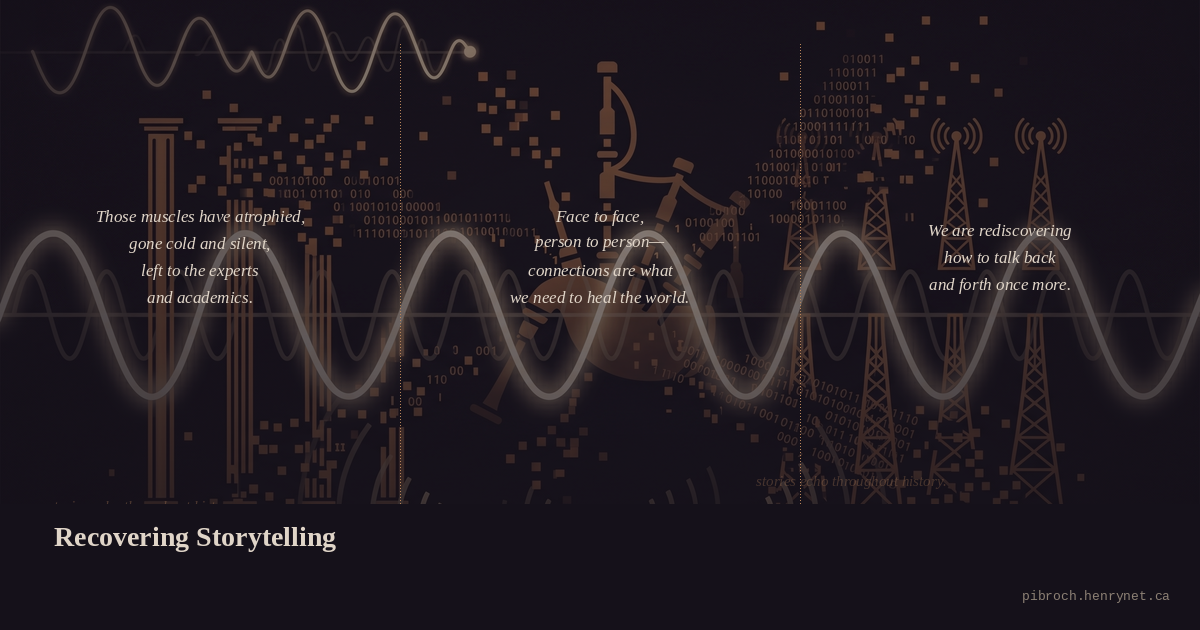
But how can we recover? Those muscles have atrophied, gone cold and silent, left to the experts and academics.
I recently attended a talk by the Indigenous journalist Jesse Wente. A major talking point that I took away from Jesse's talk was how he described the way that the Indigenous peoples deal with relationships with one another — that a person's place in the world was an integral part of who they are, their connection to the land and the water of where they lived was an immense part of their introductions to each other. This grounding of people, of establishing relationships in a one-to-few or one-on-one manner, is the exact muscle those who grew up in broadcast media need to flex to combat the modern broadcast onslaught.
It is no secret to me that Indigenous peoples seem to value relationships, because that's exactly what the societies mired in broadcast media seem to have lost — the ability to form relationships between peers, between elder and youth, between neighbour and neighbour, without framing it as some sort of antagonistic event.
So there is hope: storytelling, story listening, sharing of stories, disseminating stories — these have been kept alive in pockets of our civilization. Indigenous storytellers can be brought forth to lead the way toward how to live in a world where everyone suddenly has a voice again. Face to face, person to person connections are what is needed to combat the broadcast hegemony. Stories, tales, jokes, between individuals and communities — this is what we need to heal the world. And those stories echo throughout history.
It's no secret that while technology has been a large part of the broadcast problem, that is not to say it cannot also be part of the solution. In relation to digital storytelling, academics are already noticing this change:
…stories are bred both collectively as well as from the unique individual voice of the storyteller, thereby influenced by both individual point-of-view, the cultural context espoused by the group and social location. As such, similar to historical oral tradition, digital storytelling in many ways also juxtaposes Western views of 'historical fact', as story and tradition are more malleable, rather than 'static'. Digital storytelling is thus growing as an important community-based practice for Indigenous communities, as the approach promotes cultural and contextual understanding, while further enhancing the fluidity of oral tradition through the use of contemporary, innovative and engaging technologies.
— Beltrán et al., 2014
The advent of the internet and digital media is now allowing the formerly one-way communication technologies of the past to become looser, beginning to allow for more inclusive and potentially conversational methodology. Digital technology is not bringing storytelling to humanity — it is beginning to break the technological chains of broadcast media and helping to turn humanity back into storytellers and story-listeners. We are rediscovering how to talk back and forth once more, reclaiming our storytelling ancestry. And those stories echo throughout history.
Telling stories is a muscle we must flex — our ancestral legacy that all humanity shares in some form or another. Some of us will be virtuosos, and others will be workday storytellers, but their stories echo throughout history.
Discussion